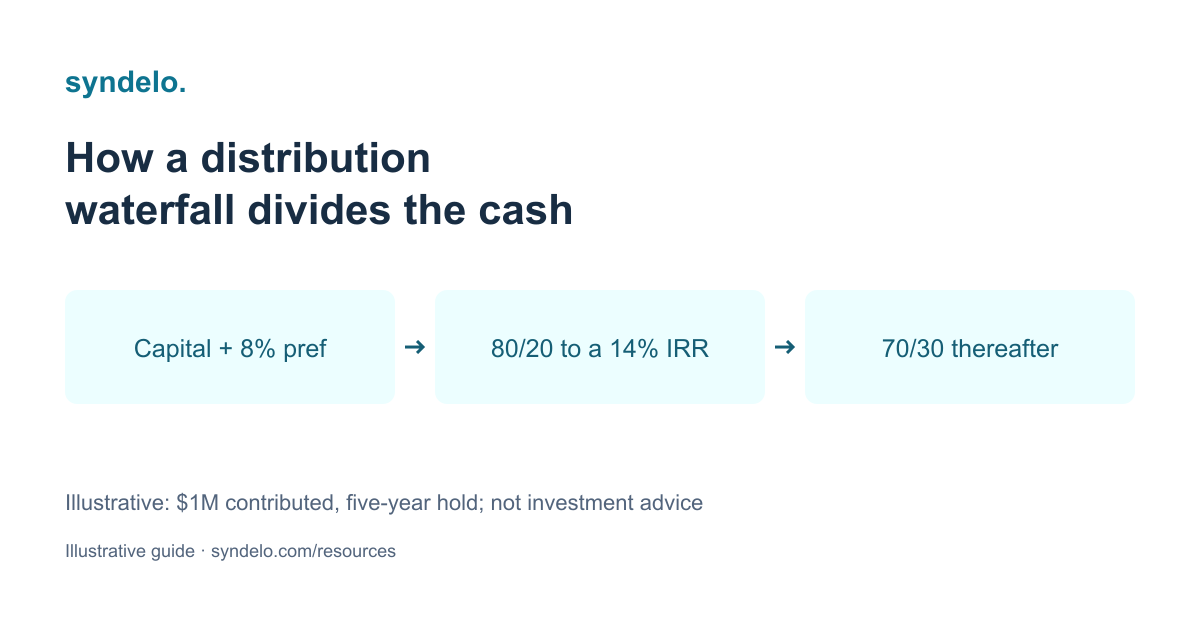
The Tiers Most Real Estate Waterfalls Use
Most real estate waterfalls are built from the same four pieces arranged in a particular order. Each tier has a limit, and cash moves to the next tier only after the previous one is satisfied. Your governing documents define the tiers and are the authority. The descriptions below are common patterns, not a standard every deal follows.
A waterfall can be applied to every distribution as it happens, or only to the total cash over the life of the deal. Either way, the same question repeats at each tier: how much is owed under this tier, how much cash is left, and who receives it.
| Tier | What It Pays | Wording to Look For |
|---|---|---|
| Return of Capital | Investors’ contributed capital, usually pro rata. | “until each Member has received distributions equal to its Capital Contributions” |
| Preferred Return | A return on unreturned capital before the sponsor shares in profit. | “an 8% cumulative, compounded annual return on unreturned Capital Contributions” |
| GP Catch-Up | A larger share to the sponsor until it holds a target share of profit. | “100% to the Manager until the Manager has received 20% of all amounts distributed as profit” |
| Promote Tiers | Splits between investors and sponsor that change as returns rise. | “70% to the Members and 30% to the Manager until the Members achieve a 14% IRR” |
Return of Capital and the Preferred Return
Return of capital pays investors back what they contributed. The preferred return, usually called the pref, is a return on that capital that investors receive before the sponsor shares in profit. An 8% pref means investors are entitled to the equivalent of 8% a year on their unreturned capital before the promote starts. It is a priority, not a promise. If the property does not produce the cash, the pref is unpaid, and whether it carries forward depends on the documents.
Deals differ in the order of these two tiers. Some pay accrued pref first and return capital second; others return capital first. During operations, the order decides whether quarterly cash reduces investors’ capital or pays their pref, which in turn changes how much pref accrues later. At a sale with enough cash to cover both, the order often makes no difference to the totals.
Deals also differ in how the pref is measured. A simple pref accrues on unreturned capital and earns nothing on unpaid amounts. A compounding pref, often written as an IRR hurdle, accrues on unpaid pref too. A cumulative pref carries any shortfall forward, while a non-cumulative pref forfeits it. Our preferred return guide works through each version with the same set of distributions.
The GP Catch-Up
Without a catch-up, the sponsor’s promote applies only to profit above the pref. If investors receive an 8% pref and the rest is split 80/20, the sponsor ends up with less than 20% of total profit, because none of the pref was shared. A catch-up tier closes that gap. After the pref, a larger share of cash goes to the sponsor until it has received its target share of all profit distributed so far. After that, the regular split applies.
Here is a single-exit illustration. Investors contribute $1,000,000. After three years with no interim distributions, the property sells and $1,500,000 is available to distribute, so total profit is $500,000. The documents provide a simple 8% cumulative pref, which totals $240,000 over three years, then an 80/20 split.
| Structure | Investors Receive | Sponsor Receives | Sponsor Share of Profit |
|---|---|---|---|
| No Catch-Up | $1,448,000 | $52,000 | 10.4% |
| 100% Catch-Up to 20% | $1,400,000 | $100,000 | 20.0% |
| 50% Catch-Up to 20% | $1,400,000 | $100,000 | 20.0% |
How the Catch-Up Numbers Work
With no catch-up, investors receive their $1,000,000, the $240,000 pref, and 80% of the remaining $260,000. The sponsor receives the other 20%, or $52,000.
With a 100% catch-up, the sponsor receives the next $60,000. That brings it to 20% of the $300,000 distributed as profit so far. The remaining $200,000 is split 80/20. A 50% catch-up reaches the same end point more slowly: $160,000 passes through the catch-up tier, half to each side, before the 80/20 split resumes on the last $100,000.
The structures only converge here because the sale produced enough cash to complete the catch-up. In a weaker outcome, the catch-up tier can absorb most of the cash above the pref, and the difference between 100% and 50% catch-up becomes material to investors. Model a downside scenario as well as the base case before you finalize terms, and show investors the outcome under both.
IRR Hurdles and Promote Tiers
Many deals scale the sponsor’s share with performance. A common pattern sends 100% of cash to investors until they reach an 8% IRR, then splits cash 80/20 until investors reach a 14% IRR, then 70/30 after that. Each hurdle is measured on investors’ actual dated contributions and distributions, so the timing of every payment matters, not just the total.
A practical way to track an IRR hurdle is a hurdle balance. Start with the capital contributed. Each period, grow the balance at the hurdle rate and subtract what investors received. While the balance is positive, investors have not yet reached that IRR, and the balance is the amount they still need. Each hurdle has its own balance. A tier that pays investors 80% of its cash needs gross cash equal to the remaining balance divided by 0.80 to clear the hurdle.
Hurdle definitions vary in ways that change the result: annual versus daily compounding, whether the sponsor’s own co-investment counts as investor capital, and whether fees are deducted before the hurdle is measured. The documents control. When an investor asks why their split changed, showing the hurdle balance is usually the clearest answer.
A Worked Example: One Deal Through Three Tiers
Assume investors contribute $1,000,000 at closing, with any sponsor co-investment included in that amount on the same terms. The deal distributes $70,000 at the end of each of years one through four. At the end of year five it distributes $70,000 of operating cash plus $1,700,000 from the sale, or $1,770,000. The waterfall pays 100% to investors until an 8% IRR, then 80/20 until a 14% IRR, then 70/30. Hurdles compound annually.
In years one through four, each $70,000 is less than the amount the 8% hurdle balance grows by, so all of it goes to investors and the shortfall compounds. By year five, investors need $1,128,666.01 to reach an 8% IRR, which is the first tier. Their 14% hurdle balance is $1,532,707.29, so after the first tier they need another $404,041.28. At an 80% share, clearing that tier takes $505,051.60 of gross cash, of which the sponsor receives $101,010.32. The remaining $136,282.39 is split 70/30.
| Year Five Tier | Investors | Sponsor | Gross Cash |
|---|---|---|---|
| 100% Until 8% IRR | $1,128,666.01 | $0.00 | $1,128,666.01 |
| 80/20 Until 14% IRR | $404,041.28 | $101,010.32 | $505,051.60 |
| 70/30 Thereafter | $95,397.67 | $40,884.72 | $136,282.39 |
| Total | $1,628,104.96 | $141,895.04 | $1,770,000.00 |
What the Example Shows
Across the five years, investors receive $1,908,104.96 on $1,000,000 contributed: a 1.91x multiple and an IRR of about 15.2%. The sponsor’s promote is $141,895.04, about 13.5% of the $1,050,000 profit. The sponsor’s share is well below 30% even though the last tier is 70/30, because most of the profit was paid entirely to investors under the 8% hurdle.
The example is illustrative arithmetic, not a forecast or a recommended structure. Rounding at each tier, the order of tiers within a period, and whether distributions are dated at the end of each year can each move the figures slightly. That is exactly why the calculation should be reproducible from dated records.
European and American Waterfalls
In private equity funds, a European or whole-fund waterfall returns all contributed capital and the pref across the fund before the sponsor receives any promote. An American or deal-by-deal waterfall calculates the promote on each investment as it is realized, so a sponsor can earn promote on an early success before later deals are resolved. American structures usually include a clawback that requires the sponsor to return promote if the fund as a whole ends below the agreed return.
Single-property syndications use the same words more loosely. Some sponsors call a structure “American” when quarterly operating cash is split after the current pref is paid, before investors have their capital back. Others use the term differently. Rather than relying on the label, ask two questions: can the sponsor receive promote before investors have their capital back, and if so, is there a clawback or lookback that settles up at the end?
How to Review a Waterfall Before You Sign or Send It
Test the waterfall against at least three scenarios: a base case, a weak case where the property underperforms, and a case with a refinance partway through the hold. Weak cases expose unclear wording, such as whether unpaid pref carries forward, or what happens when a quarter’s cash is below the pref.
- Confirm the order of return of capital and pref, and whether the pref is cumulative and compounding.
- Identify the date pref starts accruing for each investor: the funding date, the closing date, or a fixed date.
- Check how sponsor co-investment is treated and whether fees reduce cash before the waterfall.
- Reproduce one investor’s allocation by hand from dated contributions and distributions.
- Have a second person approve the calculation before notices are sent or money moves.
- Keep the inputs and outputs with the distribution record so a later question can be answered from the record.
Run Waterfalls From the Same Records as Your Investors
Waterfall errors usually come from inputs, not formulas: a contribution recorded on the wrong date, a transfer missed, or a class with different terms. Calculating from the same contribution and distribution records investors see in their statements removes a whole category of mistakes.
Syndelo calculates distributions with a preferred return, return of capital, configurable LP/GP splits, GP catch-up, tiered IRR hurdles, share-class terms, and multiple co-GPs. A second team member approves each calculation, and approved distributions produce a payment register you can export for your bank. Compounding preferred-return options are planned, and ACH distributions are not live yet. To try your own numbers, use the free distribution waterfall calculator.
This guide is educational. It is not legal, tax, or investment advice; your operating agreement and your advisers determine how your waterfall works.
Free Calculators
Put the Workflow Into Practice
Explore how Syndelo supports this part of investor management, then try the sample-data demo or discuss your requirements with us.
Explore Distribution Waterfall Software