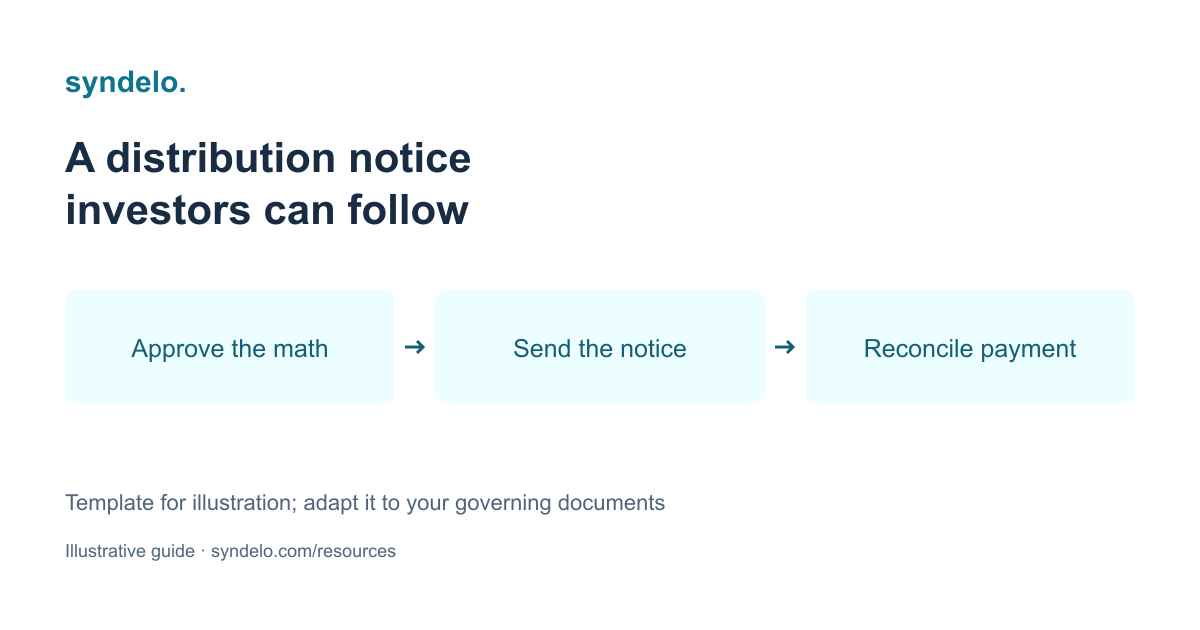
Before You Send: Settle the Calculation
The notice is only as good as the calculation behind it. Before drafting anything, confirm the cash available to distribute, the period, and which investors and classes participate. Run the waterfall from dated contributions and prior distributions, and have someone other than the preparer review it.
- Confirm distributable cash after reserves, debt service, and any fees the agreement deducts first.
- Confirm the record date and each investor’s ownership on that date, including transfers.
- Run the waterfall and check each tier: pref, return of capital, catch-up, and splits.
- Reconcile the total allocated to the cash available, to the cent.
- Confirm each investor’s payment method and bank details through a controlled process.
- Check reinvestment elections and any withholding requirements with your accountant.
- Get approval from a second person before notices go out or money moves.
What the Notice Should Include
Investors read distribution notices quickly and come back to them at tax time. Lead with the amount and the date, then explain the calculation in plain language.
Explain that a distribution is not the same as taxable income. In a partnership, each investor’s share of taxable income is reported on their Schedule K-1, and it can differ significantly from the cash they received during the year. Investors who understand that early ask fewer questions in March.
| Element | Why It Matters |
|---|---|
| Investment and Investing Account | Investors who hold through several entities need to know which account was paid. |
| Distribution Type | Operating cash flow, refinance proceeds, and sale proceeds are read differently. |
| Period or Event | Ties the amount to a quarter or a transaction. |
| Gross Amount and Components | Shows how much was preferred return, return of capital, and profit share. |
| Deductions or Withholding | Explains any difference between gross and net. |
| Net Amount, Method, and Date | Lets investors match the deposit. |
| Unpaid Preferred Return | Shows what is still owed under a cumulative pref. |
| Contact for Questions | Gives investors a place to report a discrepancy. |
Distribution Notice Template
Copy this template and adapt it to your governing documents and your counsel’s guidance. Replace each bracketed field, and remove lines that don’t apply, such as withholding or reinvestment.
Distribution Notice
Subject: [Investment Name] Distribution for [Period]

Dear [Investor Name],

[Sponsor Name] has approved a distribution from [Investment Name] for [Period]. This notice covers the distribution to [Investing Account Legal Name].

Distribution Summary
- Distribution type: [Operating cash flow / Refinance proceeds / Sale proceeds]
- Record date: [Date]
- Payment date: [Date]
- Payment method: [ACH / Wire / Check] to the account ending in [Last Four Digits]

How Your Amount Was Calculated
- Preferred return: [$ Amount]
- Return of capital: [$ Amount]
- Share of remaining cash: [$ Amount]
- Gross distribution: [$ Amount]
- Less [withholding or other deduction, if any]: [$ Amount]
- Net distribution: [$ Amount]

Your Position After This Distribution
- Capital contributed to date: [$ Amount]
- Capital returned to date: [$ Amount]
- Unreturned capital: [$ Amount]
- Unpaid preferred return carried forward: [$ Amount]
- Total distributions to date: [$ Amount]

[One or two sentences on what generated the cash, such as stabilized operations or the refinance that closed on (Date).]

[If you elected to reinvest: (Percentage)% of this distribution, or (Amount), was reinvested in (Investment Name) under your election dated (Date).]

This distribution is not the same as your taxable income for the year. Your share of income, deductions, and credits will be reported on your Schedule K-1, which we expect to send by [Date].

If any detail above doesn't match your records, or your payment hasn't arrived by [Date], contact [Name] at [Email] or [Phone]. We will never ask you to confirm or change bank details by email. If you receive a request like that, call us at a number you already have.

[Sponsor Name]
[Investor Portal Link]
Notes for Each Type of Distribution
The template works for every distribution, but investors read each type differently. Add a sentence or two that addresses what they will want to know.
- Operating cash flow: say how the amount compares with the prior period and with the plan, and whether the pref was fully paid.
- Refinance proceeds: explain how much capital was returned, how that changes future pref, and how the new loan affects cash flow.
- Sale proceeds: show the full waterfall on the sale, including any catch-up or promote, and say when the final K-1 is expected.
- Reduced or paused distributions: explain why, what has to change, and when you expect to reassess. Investors take silence worse than bad news.
- Corrections: identify the original notice, what changed, and why, and keep both versions in the record.
Timing and Cadence
Send the notice before the payment arrives, so investors are not left guessing about an unexplained deposit. Most sponsors pick a regular schedule, such as quarterly within a set number of days after quarter end, and say in the offering documents and the first update what that schedule is. Consistency matters more than speed. A distribution that arrives on the same schedule every quarter builds confidence; one that moves around invites questions even when the amount is unchanged.
If the schedule has to change, tell investors before the expected date, not after it passes. The same applies when a distribution will be smaller than the last one: a short explanation in advance prevents a wave of emails.
Delivering the Notice
Send the notice by email and post the same version where investors already look for records, such as the investor portal, so it is still easy to find at tax time. Keep sensitive details out of the email itself: show only the last four digits of a bank account, and never include full account or tax identification numbers. Address each notice to the investing account that was paid, not just the person, so an investor with several entities can tell the notices apart. Keep the exact delivered version with the distribution record; if you later send a correction, the original should remain available alongside it.
Questions Investors Ask After a Distribution
A notice that answers these questions up front saves your team time. If the same question keeps coming back, add the answer to the template.
- Why is this amount different from last quarter? Give the reason in one sentence, such as a seasonal expense, a capital project, or a change in occupancy.
- Is this return of capital or profit? Show the components, because return of capital reduces the base for future pref.
- Why don’t my taxable income and my distributions match? Point to the Schedule K-1 and explain that taxable income is allocated under the agreement and tax rules, not by cash received.
- When is the next distribution? Give the expected date or the condition that has to be met.
- Where can I see my history? Point to the investor portal or the account statement.
After the Payment: Reconcile and Record
A notice confirms intent; the bank confirms the payment. After the payment date, match each payment to its investor, follow up on returned or rejected payments, and record the distribution against each investing account. If a payment fails, tell the investor promptly and record the reissued payment separately from the original.
- Reconcile total payments to the approved payment register.
- Investigate returned or rejected payments within a business day or two.
- Post each distribution to the investor’s history so the portal and statements agree.
- Keep the approved calculation, the notice, and the payment evidence together.
- Note recurring investor questions and answer them in the next notice.
Where Syndelo Fits
Syndelo calculates each investor’s distribution under your waterfall, requires a second team member to approve it, and creates a payment register you can export as a CSV for your bank. Investors see their distribution history in the investor portal. ACH distributions are planned and not live yet. To model a waterfall before you write the notice, try the free distribution waterfall calculator.
This template is a starting point for investor communication, not legal or tax advice. Confirm notice requirements in your operating agreement with counsel.
Free Calculators
Put the Workflow Into Practice
Explore how Syndelo supports this part of investor management, then try the sample-data demo or discuss your requirements with us.
Explore Distribution Waterfall Software