What a Preferred Return Is, and Isn’t
The pref is a position in the distribution waterfall. Investors receive distributions up to the pref amount before cash moves to the sponsor’s promote. It is not a guaranteed return, an interest rate on a loan, or a promise that cash will be available. If a property earns less than the pref, investors receive less, and the documents decide what happens to the shortfall.
The pref is usually calculated on unreturned contributed capital. When capital is returned, for example from a refinance, the base shrinks and so does future pref. In funds that call capital over time, pref generally runs on capital actually contributed rather than on the full commitment, because uncalled commitments have not been invested yet. Confirm which base your documents use.
- A pref sets priority between investors and the sponsor; it does not create cash.
- A higher pref rate does not make a deal safer; it changes who bears a shortfall.
- The rate is only half of the definition. The other half is how unpaid amounts are treated.
Cumulative vs. Non-Cumulative
A cumulative pref carries any shortfall forward. If investors are owed $8,000 for a year and receive $5,000, the $3,000 difference is added to what they are owed next year and must be paid before the sponsor shares in profit. Real estate syndications commonly use a cumulative pref, and investors tend to assume it unless told otherwise.
A non-cumulative pref resets each period. Unpaid pref for the year is forfeited, and next year starts fresh. Non-cumulative structures favor the sponsor when cash flow is uneven, so investors ask about them. If you use one, say so plainly in offering materials, distribution notices, and investor reports.
Simple vs. Compounding
A simple pref accrues only on unreturned capital. Unpaid pref accumulates but earns nothing itself. A compounding pref accrues on unreturned capital plus unpaid pref, so a shortfall grows over time. Compounding is usually annual or quarterly. An IRR hurdle, such as “until investors achieve an 8% IRR,” compounds by definition, because an IRR accounts for the timing of every cash flow.
The difference is small in a good year and grows during a weak stretch. It also grows with the length of the shortfall, which is why the definition matters most in value-add and development deals where early cash flow is thin and the pref may go unpaid for several years.
A Worked Example: Same Distributions, Three Results
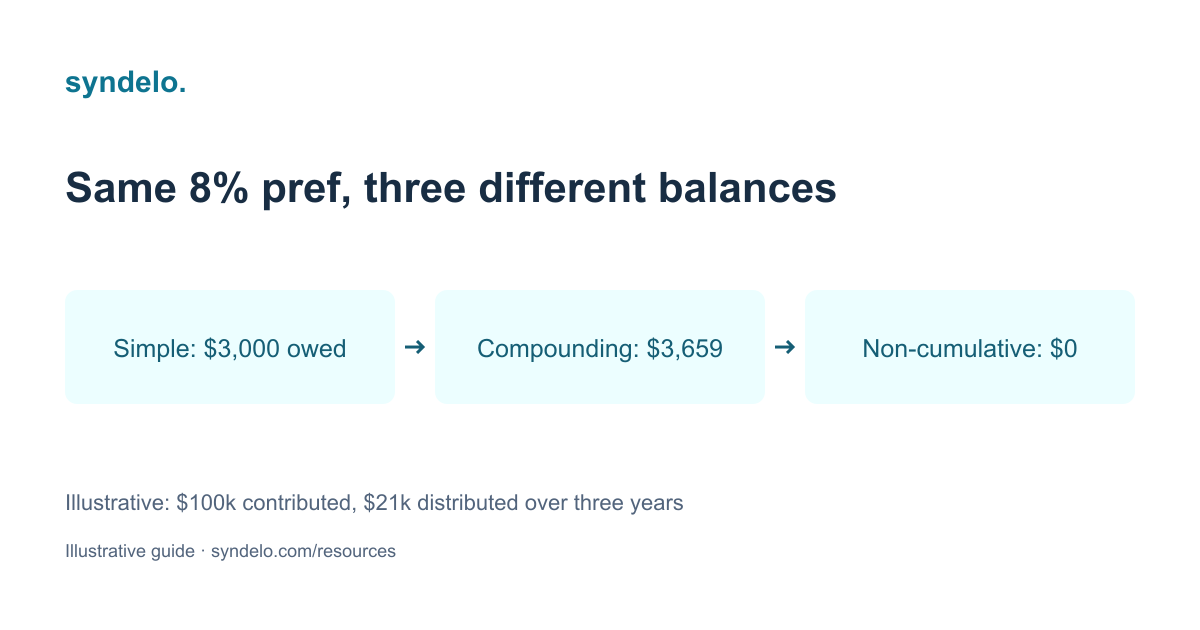
An investor contributes $100,000 to a deal with an 8% pref. The deal distributes $5,000 in year one, $6,000 in year two, and $10,000 in year three. No capital is returned during the period. The table shows what remains owed, or forfeited, at the end of each year under each definition.
| Year | Simple, Cumulative: Unpaid | Compounding Annually: Unpaid | Non-Cumulative: Forfeited |
|---|---|---|---|
| Year 1 ($5,000 Paid) | $3,000.00 | $3,000.00 | $3,000.00 |
| Year 2 ($6,000 Paid) | $5,000.00 | $5,240.00 | $2,000.00 |
| Year 3 ($10,000 Paid) | $3,000.00 | $3,659.20 | $0.00 |
How the Example Is Calculated
Under the simple cumulative pref, each year adds $8,000, which is 8% of $100,000. Year one leaves $3,000 unpaid. Year two’s amount due is $11,000, so $5,000 remains after the $6,000 distribution. Year three’s amount due is $13,000, so $3,000 remains after the $10,000 distribution, and that $3,000 must be paid before the sponsor participates.
Under annual compounding, year two accrues 8% on $103,000, or $8,240, so $5,240 remains after the $6,000 distribution. Year three accrues 8% on $105,240, or $8,419.20, so $3,659.20 remains. The gap with the simple version is only $659.20 after three years, but it widens every year the shortfall continues.
Under the non-cumulative version, $3,000 is forfeited in year one and $2,000 in year two. Year three’s $10,000 exceeds that year’s $8,000 pref, so nothing is owed going into year four, and the extra $2,000 moves to the next tier of the waterfall. None of these numbers is a forecast. They show why investors ask which definition applies, and why reports should show the unpaid pref balance, not just distributions paid.
Current-Pay and Accrued Pref
Some deals pay the pref currently: each quarter’s operating cash goes first to that quarter’s pref, and investors expect a regular distribution. Others accrue the pref and pay it mostly at a refinance or sale, which suits value-add and development plans with little early cash flow. Many deals combine the two: a current distribution target with any shortfall accruing under a cumulative pref.
Be precise about which you are offering. If marketing materials show an 8% pref next to a projected 6% cash yield, investors may read the pref as a distribution promise. Say how much of the pref you expect to pay currently, how much will accrue, and when you expect the accrued amount to be paid.
Choosing a Pref When You Structure a Deal
The pref should fit the business plan. A cumulative, compounding pref on a deal with thin early cash flow builds a balance that must be paid before the sponsor earns any promote, which can push the sponsor’s economics entirely to the exit. A non-cumulative pref on the same deal shifts that risk to investors. Neither is wrong, but each should be a deliberate choice that you can explain.
- Model the pref against the projected cash flow, a weaker case, and a delayed exit.
- Check how the pref interacts with the promote tiers and any catch-up.
- Write the definition so a new team member could calculate it without asking you.
- Use the same definition in the operating agreement, the offering summary, and investor statements.
Details That Change the Amount
Beyond the headline rate, a handful of definitions decide the dollars. Read them together, because they interact.
- Start date: whether pref accrues from the date each investor’s funds arrive, the closing date, or another fixed date.
- Day count: actual days over a 365-day year and a 30/360 convention produce different quarterly amounts. On $100,000 at 8%, a 92-day quarter is $2,016.44 under actual/365 and $2,000.00 under 30/360.
- Capital base: unreturned contributed capital or another defined amount, and how partial returns of capital reduce it.
- Classes: whether different share classes earn different prefs, and how those classes rank against each other.
- Order of payment: whether distributions pay accrued pref before returning capital.
- Sponsor co-investment: whether the sponsor’s own capital earns the same pref on the same terms.
Questions Investors Ask About the Pref
Answer these in your offering materials and keep the answers consistent in every update. Investors compare what they were told at subscription with what their statements show.
- Is the pref guaranteed? No. It sets the order of payment if cash is available.
- Does unpaid pref ever go away? Under a non-cumulative pref, yes, each period. Under a cumulative pref, it stays owed until paid or until the deal ends without the cash to pay it.
- Does a refinance distribution pay pref or return capital? It depends on the waterfall’s order of tiers. Say which before the refinance, not after.
- If I invest late in the raise, when does my pref start? It depends on the start-date definition. Investors funding on different dates may accrue different amounts.
- Does the pref compound? Only if the documents say it does, or the hurdle is defined as an IRR.
Show the Pref in Investor Reporting
Investors understand a pref best when their statements show three numbers for the period: pref accrued, pref paid, and unpaid pref carried forward. Pair those with contributions and distributions to date. If you change how an amount is calculated, explain the change in the update rather than letting a balance shift without comment.
Syndelo calculates a simple preferred return accrued on contributed capital using actual days over a 365-day year, followed by optional return of capital and LP/GP splits. Each investor’s line shows the pref paid and any pref still unpaid. Compounding preferred-return options are planned. To compare simple and compounding pref on your own numbers, use the free preferred return calculator.
This guide is educational and is not legal, tax, or investment advice. Your governing documents define your pref.
Free Calculators
Put the Workflow Into Practice
Explore how Syndelo supports this part of investor management, then try the sample-data demo or discuss your requirements with us.
Explore Distribution Waterfall Software