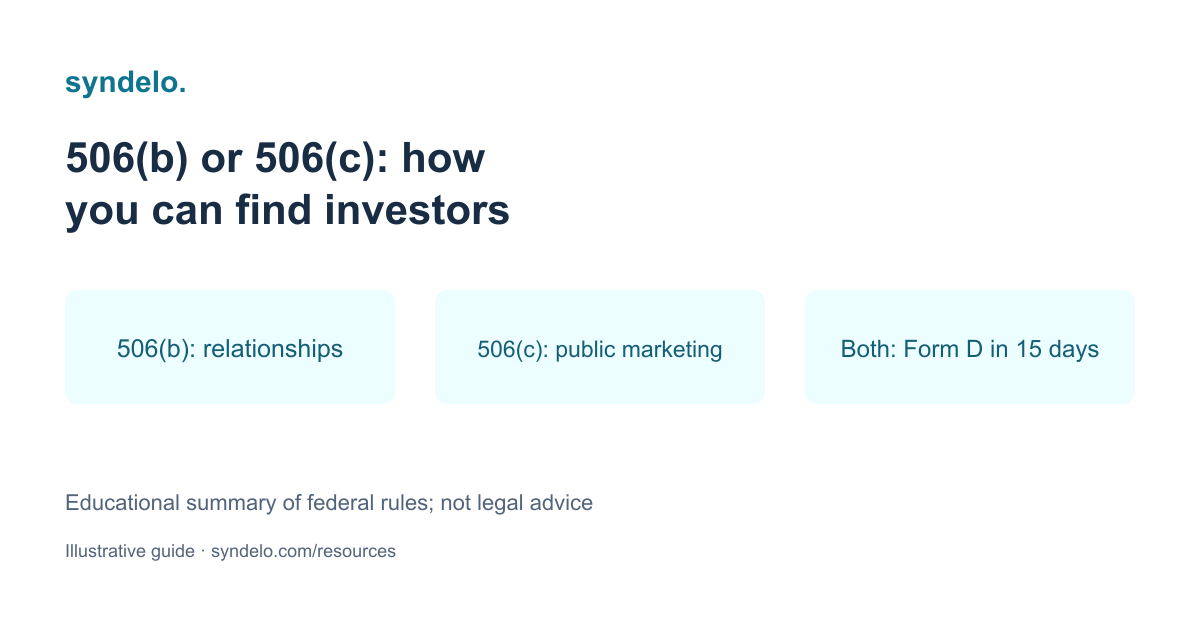
The Differences at a Glance
Several requirements are the same on both paths. The issuer files Form D, makes any required state notice filings, screens covered persons for bad actor disqualification, and treats the securities as restricted. The antifraud provisions of the securities laws apply either way, so what you say about a deal must be accurate and complete whichever exemption you use.
| Requirement | Rule 506(b) | Rule 506(c) |
|---|---|---|
| General Solicitation | Not permitted. | Permitted. |
| Who Can Invest | Accredited investors, plus up to 35 non-accredited purchasers in any 90-calendar-day period. | Accredited investors only. |
| Non-Accredited Purchasers | Must be sophisticated, alone or with a purchaser representative, and receive specified disclosure. | Not permitted. |
| Accredited Status | Reasonable belief; an investor questionnaire is common. | Reasonable steps to verify, such as documents, a third-party letter, or a high minimum with written representations. |
| Form D | Within 15 calendar days after the first sale. | Within 15 calendar days after the first sale. |
| State Requirements | No state registration; states may require notice filings and fees. | Same as 506(b). |
| Bad Actor Rules | Apply. | Apply. |
| Resale | Restricted securities. | Restricted securities. |
General Solicitation and Pre-Existing Relationships
Rule 502(c) prohibits general solicitation and general advertising in a 506(b) offering. The rule’s examples include advertisements, articles, and notices in newspapers, magazines, television, or radio, and seminars or meetings whose attendees were invited through general solicitation. SEC staff guidance treats an unrestricted public website that offers securities as general solicitation. Social media posts, podcasts, and public webinars that describe an open offering raise the same question.
In practice, 506(b) sponsors offer deals to people with whom they have a pre-existing, substantive relationship. SEC staff guidance describes a relationship as pre-existing when it was formed before the offering began, and as substantive when the issuer has enough information to evaluate, and does evaluate, the prospective investor’s financial circumstances and sophistication. Self-certification alone is not enough. There is no minimum waiting period, but the relationship must be established before the offering commences.
Sharing factual business information that does not offer securities is generally permitted. The line is whether a communication offers securities to people you lack a relationship with. Ask counsel to review your website, newsletter, and social media practices before a 506(b) raise, and keep offering pages behind an invitation.
- Record how and when you met each prospective investor.
- Record what you learned about their financial circumstances and investing experience, and when.
- Keep deal materials behind invite-only access for 506(b) offerings.
- Check that public content describes your business and track record, not an open offering.
Non-Accredited Investors in a 506(b) Offering
Rule 506(b) allows no more than 35 purchasers who are not accredited in Rule 506(b) offerings in any 90-calendar-day period. Accredited investors do not count toward the limit, and certain related purchasers, such as a relative who shares the purchaser’s primary residence, are excluded from the count. Each non-accredited purchaser must have enough knowledge and experience in financial and business matters to evaluate the merits and risks of the investment, alone or with a purchaser representative, or the issuer must reasonably believe so immediately before the sale.
Selling to even one non-accredited investor triggers Rule 502(b). The issuer must furnish specified information a reasonable time before the sale. For an issuer that does not file reports with the SEC, that means disclosure of the kind required in a Regulation A offering circular or a registration statement, including financial statement information, plus an opportunity to ask questions and receive answers. Rule 502(b) also notes that issuers should consider giving the same information to accredited investors in view of the antifraud provisions.
Many sponsors limit 506(b) offerings to accredited investors to avoid this disclosure burden. If a friend or family member who is not accredited wants to invest, ask counsel what the disclosure package would require for your deal before you agree.
Verifying Accredited Investors in a 506(c) Offering
In a 506(c) offering, every purchaser must be accredited, and the issuer must take reasonable steps to verify it. A checked box on a questionnaire is not enough by itself. Rule 506(c) describes non-exclusive methods for natural persons: reviewing IRS forms reporting income for the two most recent years with a written representation about the current year; reviewing asset statements and a consumer report dated within the prior three months with a written representation that all liabilities are disclosed; obtaining a written confirmation from a registered broker-dealer, SEC-registered investment adviser, licensed attorney, or CPA who verified status within the prior three months; and, for a person the issuer previously verified, relying on a written representation for up to five years.
In March 2025, SEC staff issued a no-action letter and updated interpretations saying a high minimum investment can support verification. Where natural persons commit at least $200,000 and legal entities at least $1,000,000, the purchaser represents in writing that it is accredited and that the minimum is not financed by a third party for the purpose of the investment, and the issuer has no actual knowledge to the contrary, the issuer may reasonably conclude it has taken reasonable steps. Our accredited investor verification guide covers each method and the entity rules in more detail.
Choosing, and Changing, Your Path
Choose 506(b) if your investors come from an existing network and you may accept a small number of sophisticated non-accredited investors. Choose 506(c) if you want to market the offering publicly and your investors are accredited and willing to verify. The investor experience differs too: 506(c) investors should expect to provide documents or a verification letter, or to meet a high minimum, before they can fund.
SEC staff guidance says an issuer that began an offering under 506(b) may elect to rely on 506(c) before making any sales, if the 506(c) conditions are met for all sales in the offering and the Form D is amended to show reliance on 506(c). Moving between the paths after sales, or running both at once, raises integration questions for counsel.
- Where will your investors come from: an existing network, or public marketing?
- Do you expect any non-accredited investors, and could you meet the disclosure requirement?
- Can your investors meet a high minimum, or will they verify with documents or a letter?
- Who will run verification, and where will you keep the evidence?
Form D, State Notice Filings, and Bad Actor Checks
File Form D on EDGAR no later than 15 calendar days after the first sale in the offering; if that day falls on a weekend or holiday, the deadline moves to the next business day. Amend it to correct a material mistake, to reflect certain changes, and annually if the offering is continuing.
Rule 506 offerings are exempt from state registration, but states may still require notice filings and collect fees. Requirements and deadlines vary, so check each state where you have a purchaser. NASAA’s Electronic Filing Depository accepts state notice filings for Rule 506 offerings in participating states.
Rule 506(d) makes the exemption unavailable if a covered person has a disqualifying event, such as certain securities-related convictions, court injunctions, or regulatory orders. Covered persons include the issuer and its predecessors and affiliated issuers; its directors, executive officers, participating officers, general partners, and managing members; owners of 20% or more of its voting equity; promoters; and anyone paid to solicit investors. Events before September 23, 2013 must be disclosed to purchasers a reasonable time before sale rather than disqualifying the offering. Have covered persons complete a questionnaire before each offering and keep it in the deal file.
Running Either Path in Syndelo
Syndelo keeps investors, investing accounts, notes, and tasks in an investor CRM, which helps you document how you know each 506(b) prospect. Data rooms support invite-only access, NDAs, and document tracking, and offering pages and subscription questionnaires collect each investor’s answers for sponsor review. Third-party accreditation verification is built but not yet switched on for live use, so 506(c) sponsors should verify through a provider or counsel for now. Syndelo does not file Form D or state notices.
This guide is educational and summarizes federal rules and SEC staff guidance current as of October 2026. It is not legal advice. Staff no-action letters and interpretations are not rules, and your counsel should confirm how they apply to your offering.
Further Reading
- 17 CFR 230.506: Rule 506 (eCFR)
- 17 CFR 230.502: Rule 502, Including General Solicitation and Information Requirements (eCFR)
- 17 CFR 230.503: Form D Filing (eCFR)
- SEC: Private Placements Under Rule 506(b)
- SEC: General Solicitation Under Rule 506(c)
- SEC: Securities Act Rules Compliance and Disclosure Interpretations
- NASAA: Electronic Filing Depository
Put the Workflow Into Practice
Explore how Syndelo supports this part of investor management, then try the sample-data demo or discuss your requirements with us.
Explore Investor Onboarding