Who Counts as an Accredited Investor
Rule 501(a) defines accredited investors. For individuals, the categories sponsors see most often are:
- Income above $200,000 in each of the two most recent years, or joint income with a spouse or spousal equivalent above $300,000 in each of those years, with a reasonable expectation of reaching the same level this year.
- Net worth above $1,000,000, alone or together with a spouse or spousal equivalent, excluding the primary residence.
- Holders in good standing of the Series 7, Series 65, or Series 82 license.
- Directors, executive officers, or general partners of the issuer, or of its general partner.
- Knowledgeable employees of a private fund, for investments in that fund.
Entities, Trusts, and the 2020 Amendments
Entities qualify in several ways. They include corporations, partnerships, LLCs, and 501(c)(3) organizations with more than $5,000,000 in total assets that were not formed to acquire the securities offered; trusts with more than $5,000,000 in assets whose purchase is directed by a sophisticated person; entities of other types that own more than $5,000,000 in investments; certain family offices with more than $5,000,000 under management and their family clients; and any entity in which all equity owners are accredited.
The professional-license, knowledgeable-employee, spousal-equivalent, family-office, and $5,000,000-in-investments categories came from amendments the SEC adopted in August 2020. If your investor questionnaire predates them, update it so investors who qualify under a newer category can select it.
For real estate syndications, investors frequently invest through an LLC, a revocable trust, or a self-directed IRA. Identify the legal purchaser first, then the category it qualifies under. An LLC formed for the deal does not meet the $5,000,000 asset test, but it can qualify if every equity owner is accredited.
Calculating Net Worth Correctly
The net worth test excludes the primary residence as an asset. Mortgage debt on that residence is also excluded, up to the home’s estimated fair market value, with two exceptions. Debt above the home’s value counts as a liability. And if the balance increased in the 60 days before the sale, other than to acquire the home, the increase counts as a liability, so an investor cannot borrow against the home just before investing to qualify.
Joint net worth can include assets that are not held jointly, and relying on joint net worth does not require the investment to be made jointly. When you use joint figures, collect the documents and written representations from both people.
The Verification Methods in Rule 506(c)
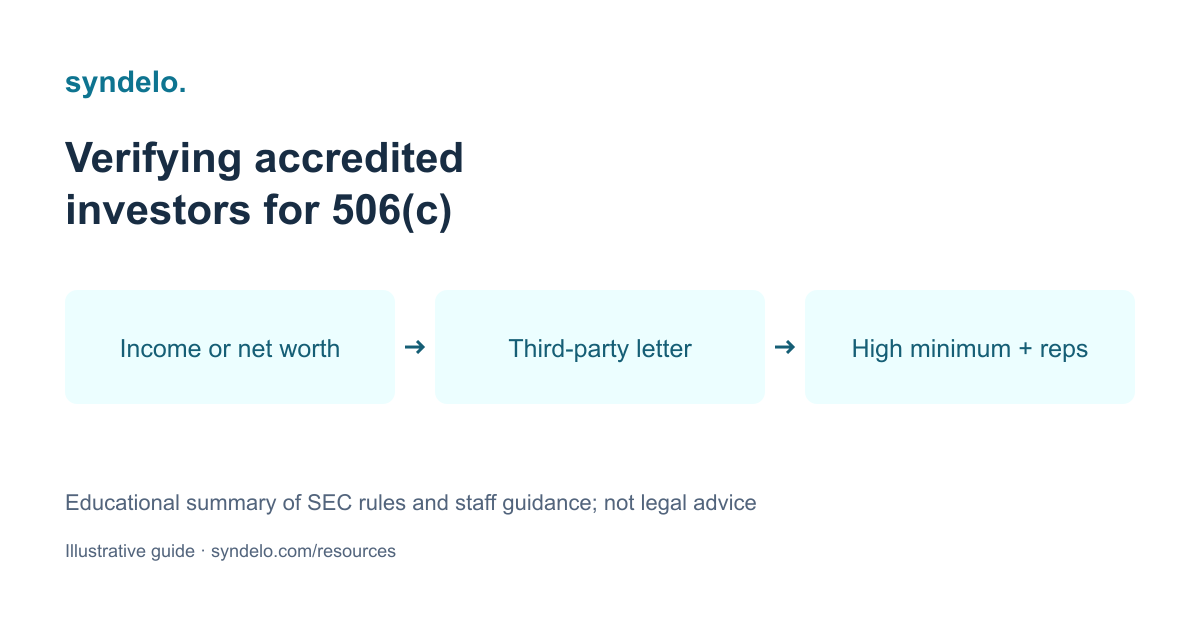
Rule 506(c)(2)(ii) lists methods that count as reasonable steps for natural persons, provided the issuer does not know the person is not accredited. They are optional. Issuers can use other reasonable steps based on the facts, such as the nature of the purchaser, the information the issuer has, and the terms of the offering.
| Method | What You Review | Timing |
|---|---|---|
| Income | IRS forms reporting income for the two most recent years, such as Form W-2, Form 1099, Schedule K-1, or Form 1040, plus a written representation about current-year income. | The two most recent years. |
| Net Worth | Assets: bank and brokerage statements, certificates of deposit, tax assessments, or independent appraisals. Liabilities: a consumer report from a nationwide agency. Plus a written representation that all liabilities are disclosed. | Documents dated within the prior three months. |
| Third-Party Confirmation | A written confirmation from a registered broker-dealer, SEC-registered investment adviser, licensed attorney, or CPA that it took reasonable steps to verify status. | Verification within the prior three months. |
| Previously Verified Investor | A written representation at the time of sale from someone you previously verified, absent contrary information. | Up to five years from the prior verification. |
The 2025 Guidance on High Minimum Investments
On March 12, 2025, staff in the SEC’s Division of Corporation Finance issued a no-action letter, and updated its interpretations, on using minimum investment amounts to verify accredited status. The staff agreed an issuer may reasonably conclude it has taken reasonable steps to verify when these conditions are met:
- The minimum investment is at least $200,000 for natural persons and $1,000,000 for legal entities. A binding commitment to contribute that amount in installments as called counts.
- For an entity accredited only because all its equity owners are accredited, the entity commits at least $1,000,000, or $200,000 per owner if its owners are fewer than five natural persons, and represents that each owner has a minimum obligation to the entity of at least $200,000 for natural persons or $1,000,000 for entities.
- The purchaser represents in writing that it is accredited and that its minimum investment is not financed, in whole or in part, by a third party for the specific purpose of making the investment.
- The issuer has no actual knowledge of facts indicating that the purchaser is not accredited or that the minimum is financed by a third party for that purpose.
Using the High-Minimum Path in Practice
The letter reflects staff views. It is not a rule, and different facts could lead to a different conclusion. If your minimum is below those amounts, the traditional methods still apply. Some sponsors offer two paths: investors committing at least the high minimum provide representations, and everyone else verifies with documents or a third-party letter.
If you use the high-minimum path, put the representations in the subscription documents, keep the signed versions with each subscription, and train the team to escalate anything that suggests a representation is untrue. Actual knowledge defeats the approach, so a note in your CRM that an investor borrowed the money for this deal matters.
Running Verification Without Stalling the Close
Verification is easiest when it is part of onboarding rather than a scramble before funding. Decide which methods you will accept before launching the raise, tell investors early what they will need, and give your reviewer a queue showing what is missing for each investing account.
- Start verification when an investor indicates interest, not after they sign.
- Verify the legal purchaser, which may be an LLC, trust, or IRA, not only the person you know.
- Record the method, date, reviewer, and documents relied on for each purchaser.
- Track time limits: net worth documents and third-party letters rely on a three-month window, and prior verification on five years.
- Store documents securely and limit access; tax returns and credit reports are sensitive.
- Do not accept funds from an unverified purchaser in a 506(c) offering.
What to Put in the Investor Questionnaire
The questionnaire is where verification starts. Ask enough to know which category applies and which method you will use, without collecting documents you do not need. For a 506(b) offering, the questionnaire and your relationship with the investor usually support a reasonable belief. For a 506(c) offering, it tells you what to verify next.
- The legal purchaser: individual, joint owners, LLC, trust, partnership, or retirement account, with the exact legal name.
- The accredited category the purchaser relies on, in plain language with the rule’s thresholds.
- For an entity relying on its owners, the list of equity owners and each owner’s category.
- The verification method the investor prefers: documents, a third-party letter, or the high-minimum representations.
- Written representations for the method chosen, including that liabilities are disclosed or that the minimum is not financed by a third party.
- Consent to contact the investor’s attorney, CPA, or adviser when a third-party letter is used.
Third-Party Letters and Verification Services
A letter from the investor’s attorney or CPA, or a verification service that coordinates the review, takes document handling off your team and keeps tax returns out of your files. Confirm the letter names the purchaser, states that the provider took reasonable steps to verify status, and is dated within three months of the sale. Under Rule 506(c), the issuer remains responsible for having taken reasonable steps, so keep each confirmation with the subscription record.
Where Syndelo Fits
Syndelo’s configurable onboarding steps and subscription questionnaires can collect each investor’s accredited category, and sponsors approve, request changes to, or decline each application. Third-party accreditation verification is built into the investor journey but is not yet switched on for live use, so for now collect verification through your provider or counsel and keep the result with the investor record.
This guide is educational and reflects federal rules and SEC staff guidance current as of October 2026. It is not legal advice.
Further Reading
- 17 CFR 230.501: Definitions, Including Accredited Investor (eCFR)
- 17 CFR 230.506: Rule 506, Including Verification Methods (eCFR)
- SEC: Accredited Investors
- SEC Press Release 2020-191: Accredited Investor Definition Amendments
- SEC Staff No-Action Letter: Latham & Watkins, Rule 506(c) (March 12, 2025)
- SEC: Securities Act Rules Compliance and Disclosure Interpretations
Put the Workflow Into Practice
Explore how Syndelo supports this part of investor management, then try the sample-data demo or discuss your requirements with us.
Explore Investor Onboarding