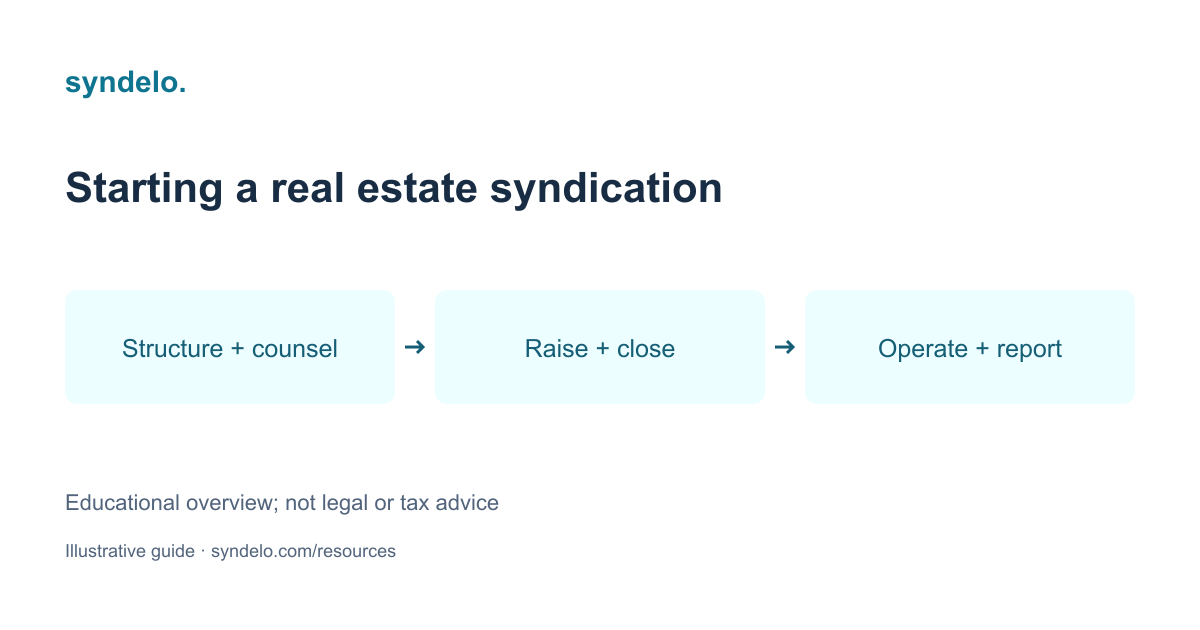
Step 1: Define the Deal and Your Role
Decide what you are offering investors: a single property, or a fund that will acquire several. A single-asset syndication lets investors evaluate a specific property, its price, and its business plan. A fund raises against a strategy before every asset is identified, which changes what you disclose, how you call capital, and how investors judge you.
Be clear about the team you bring. Investors will ask who sources the deal, who manages the property, who handles reporting and taxes, and what happens if a key person leaves. Lenders ask similar questions, and a principal may need to sign a loan guarantee. Settle these roles before you approach investors, because they appear in the offering documents and in the fees you charge.
- What is the business plan, and what has to go right for it to work?
- How much equity do you need, including reserves and closing costs?
- What will you invest yourself, and on what terms?
- What fees will the sponsor earn, and for what work?
Step 2: Set Up the Structure
A common structure uses two entities. The property-owning entity, often an LLC or limited partnership, issues interests to investors and to the sponsor. A separate management entity controlled by the sponsor serves as manager or general partner. The operating agreement or partnership agreement sets out governance, the distribution waterfall, fees, capital calls, transfer restrictions, reporting obligations, and what happens at a sale.
For federal tax purposes, a multi-member LLC or limited partnership is commonly treated as a partnership. A partnership files Form 1065, and each partner receives a Schedule K-1 showing its share of income, deductions, and credits. Your accountant should confirm the classification, the state filings, and how the entity will handle investors who invest through IRAs or from other states.
| Document | What It Does |
|---|---|
| Operating or Partnership Agreement | Defines ownership, governance, fees, the waterfall, capital calls, and transfers. |
| Private Placement Memorandum | Describes the offering, the property, the business plan, risks, conflicts of interest, and fees. |
| Subscription Agreement | The investor’s agreement to buy interests, with representations about status and suitability. |
| Investor Questionnaire | Collects the investing account, tax details, and accredited status. |
Step 3: Treat the Raise as a Securities Offering
Interests in a syndication are generally securities. Unless the offering is registered, which is rare for a private real estate deal, it needs an exemption, and most syndications rely on Rule 506 of Regulation D. Rule 506(b) prohibits general solicitation and allows a limited number of sophisticated non-accredited investors. Rule 506(c) allows public marketing but only accredited investors, whose status you must take reasonable steps to verify.
Hire securities counsel before you market the deal. Counsel drafts or reviews the offering documents, confirms the exemption, and advises on what you can say publicly. Be careful about paying anyone to bring in investors: transaction-based compensation for raising capital raises broker-dealer registration questions, and anyone paid to solicit purchasers is a covered person under the Rule 506 bad actor rules. Our guide to 506(b) and 506(c) explains the two paths in more detail.
Step 4: Build Your Investor List and Raise
Your investor CRM is the foundation of the raise. Record each relationship, what you know about the investor’s experience and goals, and every conversation. For a 506(b) offering, that record also documents the pre-existing, substantive relationships the exemption relies on.
Present the deal through an offering page or data room that holds the PPM, operating agreement, financial model, and property materials. For a 506(b) offering, keep it behind an invitation. Track soft commitments separately from signed subscriptions so you always know how much is actually committed, and update your plan if the raise is running short of the closing date.
- Set a minimum investment, a target raise, and a deadline for subscriptions.
- Decide which investing accounts you accept: individuals, joint accounts, LLCs, trusts, and self-directed IRAs.
- Prepare consistent answers about fees, the waterfall, the business plan, and the main risks.
- Agree internally who answers investor questions and where answers are recorded.
Step 5: Subscribe, Fund, and Close
Each investor completes the questionnaire, signs the subscription agreement, and funds. Review each subscription before accepting it: confirm the legal investor, the amount, accredited status and any required verification, and that the documents are complete and signed by the right person. Countersign accepted subscriptions and record each investor’s commitment and contribution.
Match each incoming wire to the investor and subscription. Confirm wiring instructions through a known channel, and never change them based on an email alone. After closing, record ownership percentages in a cap table that reconciles to contributions.
File Form D on EDGAR no later than 15 calendar days after the first sale, and make any notice filings required by the states where your investors live. Counsel often handles these filings, but the sponsor should track that they were made.
Step 6: Operate, Distribute, and Report
After closing, the investor side becomes a recurring operation. Calculate distributions under the waterfall, have a second person approve them, and pay investors with a notice that shows how their amount was determined. Send updates on a predictable schedule; quarterly updates covering operations, financing, and distributions, with account statements alongside, are a common rhythm.
Each year, deliver K-1s. A partnership’s Form 1065 is due by the 15th day of the third month after its tax year ends, which is March 15 for a calendar-year partnership, and partners must receive their Schedule K-1s by the same date. Form 7004 provides an automatic six-month extension. Tell investors when to expect their K-1s so they can plan their own filings.
If the deal needs more capital, the operating agreement’s capital call provisions determine what you can ask for and what happens when an investor does not fund. Read them before you need them.
Step 7: Plan the Exit
A sale or refinance produces the largest distribution of the deal and the most investor attention. Run the waterfall on the actual proceeds, reconcile it, have it approved, and explain it in the distribution notice. After a final sale, deliver final K-1s and wind down the entity under the operating agreement.
Keep the deal file complete from the start: offering documents, subscription records, verification evidence, Form D and state filings, distributions, and investor communications. A clean file makes the exit, an audit, or your next raise much easier.
Sponsor Fees and Alignment
Investors evaluate the sponsor’s fees alongside the promote. Syndications commonly include some combination of an acquisition fee, an asset management fee, a refinance fee, a construction or development management fee, and a disposition fee. Each should be defined in the operating agreement and disclosed in the offering documents, including when it is paid, how it is calculated, and whether it is paid before or after investors receive distributions.
Alignment matters as much as the amounts. Investors look at how much the sponsor is investing, whether fees are paid regardless of performance, and whether the promote is earned only after investors receive their capital and pref. Explain your choices plainly, and make sure your distribution calculations deduct fees exactly as the agreement describes.
Common First-Deal Mistakes
First-time sponsors tend to run into the same problems. Most come from treating the investor side as paperwork rather than an operation that lasts the life of the deal.
- Marketing a 506(b) offering publicly, or starting the raise before counsel has confirmed the exemption.
- Accepting subscriptions without confirming who the legal investor is.
- Tracking commitments, contributions, and ownership in separate spreadsheets that drift apart.
- Calculating distributions without a second reviewer.
- Missing the Form D deadline or state notice filings.
- Promising investors a reporting schedule you cannot keep.
Where Syndelo Fits
Syndelo runs the investor side of a syndication: an investor CRM, offering pages and data rooms, subscription questionnaires and sponsor review, capital calls, distribution calculations with two-person approval, investor updates, K-1 delivery, and a branded investor portal. eSign and third-party accreditation verification are built but not switched on for live use, and investor payments run in a sandbox for now. Syndelo does not provide legal, tax, or fund administration services.
Further Reading
Put the Workflow Into Practice
Explore how Syndelo supports this part of investor management, then try the sample-data demo or discuss your requirements with us.
Explore Syndication Software